Article Aug 23, 2026, 05:32 PM
Can Pirated Software Be Affected by Ransomware? Know the Risks Before Your Data Gets Locked
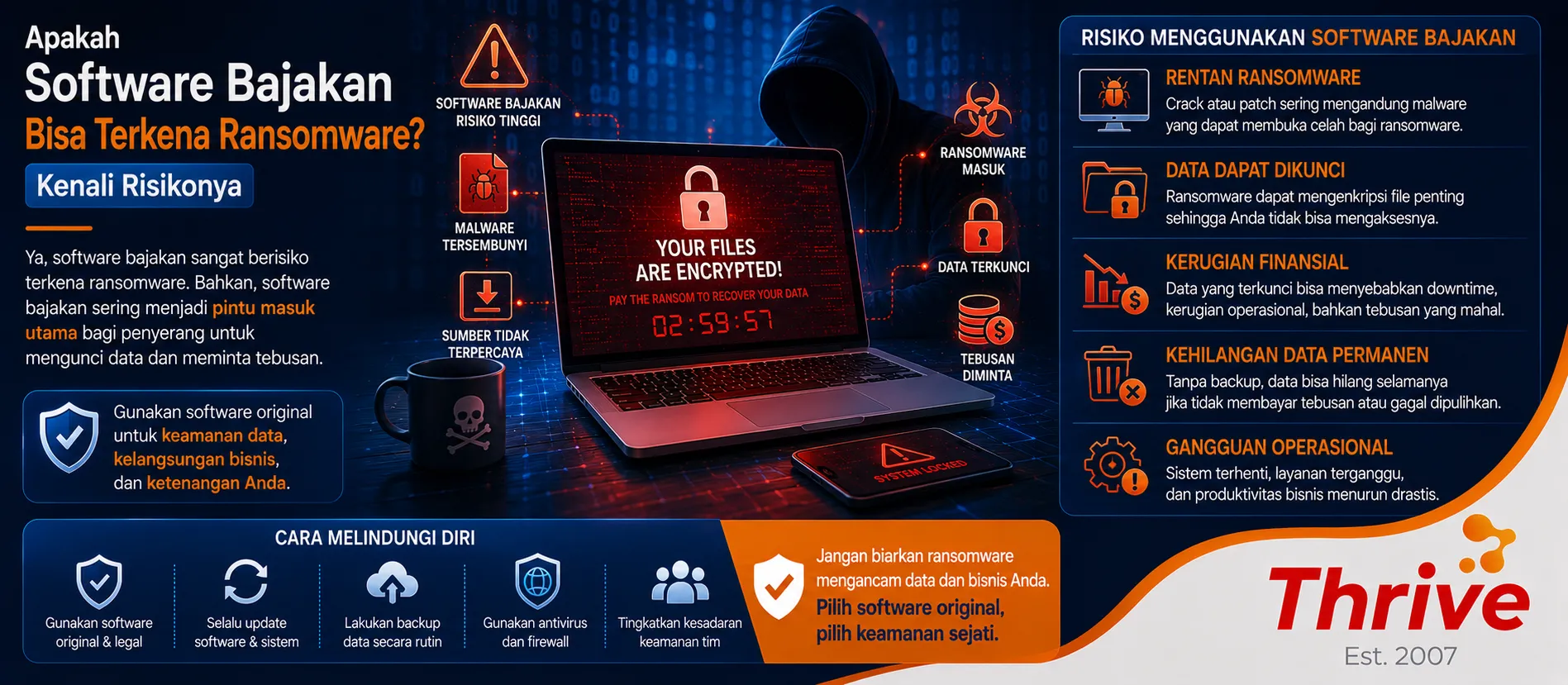
Yes,Pirated software can be one of the entry points for ransomware, especially if users install cracks, activators, patches, or installers modified by unknown parties. Pirated software doesn't necessarily contain ransomware, but the unverifiable source of the files increases the risk.
For companies, the impact can be much greater, as a single computer can access email, shared folders, cloud storage, and even internal systems. Therefore, it's best to be safe before using software from unknown sources. search for software licensesthrough trusted channels.
How Dangerous is the Risk?
Some things to understand from the start:
Crack and activator can be insertedransomware or other malware.
Ransomware can encrypt files accessible by the infected account or device.
Shared folders and network drives are also potentially affected if they are accessible to malware.
Request forturn off antivirusduring installation is a red flag.
Recovery can take hours to days, depending on the scale of the attack and the readiness of backups.
That is, the decision search for software licensesIt's not just about legality. For businesses, using trusted software is part of security risk management.
How Can Pirated Software Pave the Way for Ransomware?
Ransomware is a type of malware that can render data or systems inaccessible, usually through encryption. In some attacks, data can also be stolen before encryption.
Pirated software increases the risk because the installation process often requires additional files that do not come from the official vendor.
1. Cracks Can Hide Malware
Users may simply want to activate the software, but the crack file is actually an executable that runs commands on the computer.
The risk increases when the instruction appears:
Extract crack → Disable antivirus → Run as Administrator → Jalankan activator.
Administrator permissions give programs broader control over the system. If the file carries ransomware, the user could unknowingly grant the malware the access it needs.
Using the official installer after search for software licensesreducing the need to run these types of activation files.
2. Turning off the antivirus opens a layer of protection.
Some cracks ask for antivirus or endpoint protection to be disabled because their activity is detected as suspicious.
The problem is, users cannot be sure whether the detection is only due to the crack mechanism or because there is actually malware.
When protection is turned off, the device actually loses one layer of security when a risky file is being executed.
Therefore, if the installation process requires security protection to be turned off, it is best to stop the process and search for software licenseswith the official activation mechanism.
3. Ransomware Can Access Company Data
Imagine ransomware running on a Finance laptop that has access to:
Invoice → Financial Report → Shared Folder → Cloud Drive → Customer Documents.
The impact has the potential to be much wider than a single laptop.
If a user account has permissions to network drives or other corporate resources, malware can try to access that data.
That is why official software needs to be combined withleast privilege access, endpoint protection, network segmentation, dan backup.
4. Security Updates Can Be Interrupted
Pirated software sometimes requires certain configurations for the crack to work, including blocking application connections or updates.
Even though security patches are needed to fix vulnerabilities.
If the application does not get patched during6–12 months, devices may remain on versions with security holes that the vendor has already fixed.
Access to official updates is an important factor when search for software licenses.
5. Backups Determine How Quickly a Business Can Recover
Antivirus alone is not enough.
Companies need to have backups that are not easily affected when an endpoint is compromised.
One of the baselines that can be used is the principle3-2-1:
3 copies of data → 2 different media → 1 separate/offsite copy.
Backups also need to be tested regularly. Having backups but never performing restore tests can create a false sense of security.
Reduce the risk from applications by search for software licensesOfficials still need to work with the backup strategy.
6. Recovery Costs Can Be More Expensive Than Licenses
Pirated software looks cheap because the initial cost is very small.
But ransomware can create costs:
Downtime + incident response + reinstall + data recovery + credential reset + lost productivity.
For example 20 employeescan't work for 8 hours. That means up to160 cumulative working hoursimpacted, even before calculating the costs of the IT team.
From a Total Cost of Ownership perspective, search for software licensesOfficial risks are much easier to calculate than the risks of unpredictable incidents.
Protect Your Computer Before an Incident Occurs
Avoid cracks, activators, patches, and key generators.
Use installers from trusted vendors or sources.
Do not turn off the antivirus to run the software.
Enable automatic security updates.
Use endpoint protection.
Implement Multi-Factor Authentication for important accounts.
Limit administrator privileges.
Apply backup3-2-1for critical data.
Perform restore tests periodically.
If paid software is required, search for software licensesbefore performing the installation.
FAQ
Does all pirated software contain ransomware?
No. However, cracks or installers from untrusted sources carry a higher risk because the contents and changes to the files are difficult to verify.
Can ransomware enter through cracks?
Yes. Crack or activator files can be modified to run malware when the user opens them.
Is antivirus enough to prevent ransomware?
No. Antivirus helps reduce risk, but companies still need patching, backup, access control, MFA, and user education.
Does ransomware only encrypt files on a computer?
Not always. Other resources accessible by user permissions, such as shared folders or network drives, are also potentially affected.
What to do if your computer is infected with ransomware?
Immediately isolate the device from the network, contact IT or security, identify the scope of the incident, protect backups, and recover through incident response procedures.
Does paying the ransom guarantee data return?
No. There is no guarantee that the perpetrator will provide a working decryption key or delete any data that may have been stolen.
How do companies reduce the risk of ransomware?
Use layered security: endpoint protection, patching, MFA, least privilege, separate backups, monitoring, and search for software licensesthrough trusted channels.
Pirated software isn't the only cause of ransomware. However, the use of unverified cracks and installers is also a factor.additional risks that could actually be avoided.
For companies, don't just rely on antivirus. Audit the applications used, strengthen backups and user access, and then... search for software licensesOfficials are required to replace unverified software. This approach allows for better management of data security and operational continuity.
Related Articles
Also read other interesting information from us

General
Why Your Business Needs a Responsive Website Today?
In today’s digital age, having a website for your business is not just an option, it’s a necessity. However, it’s not ju...

General
Understanding Crypto Exchanges: What they are and How to Choose the Right Exchange
You may have heard the term stock exchange, a domain that is built through certain technology and allows investors to ca...

General
5 Reasons Why a Quality Secondhand Laptop is the Right Choice for Your Business
In managing a business, spending efficiency is crucial. Many companies are now starting to turn toquality second hand la...
Get Free Consultation
Discuss your company's IT needs with our customer support right now at
+62 822 9998 8870


