Article Sep 28, 2026, 06:50 AM
Software Licenses Look Expensive? Compare Them with the Cost of System Failure First
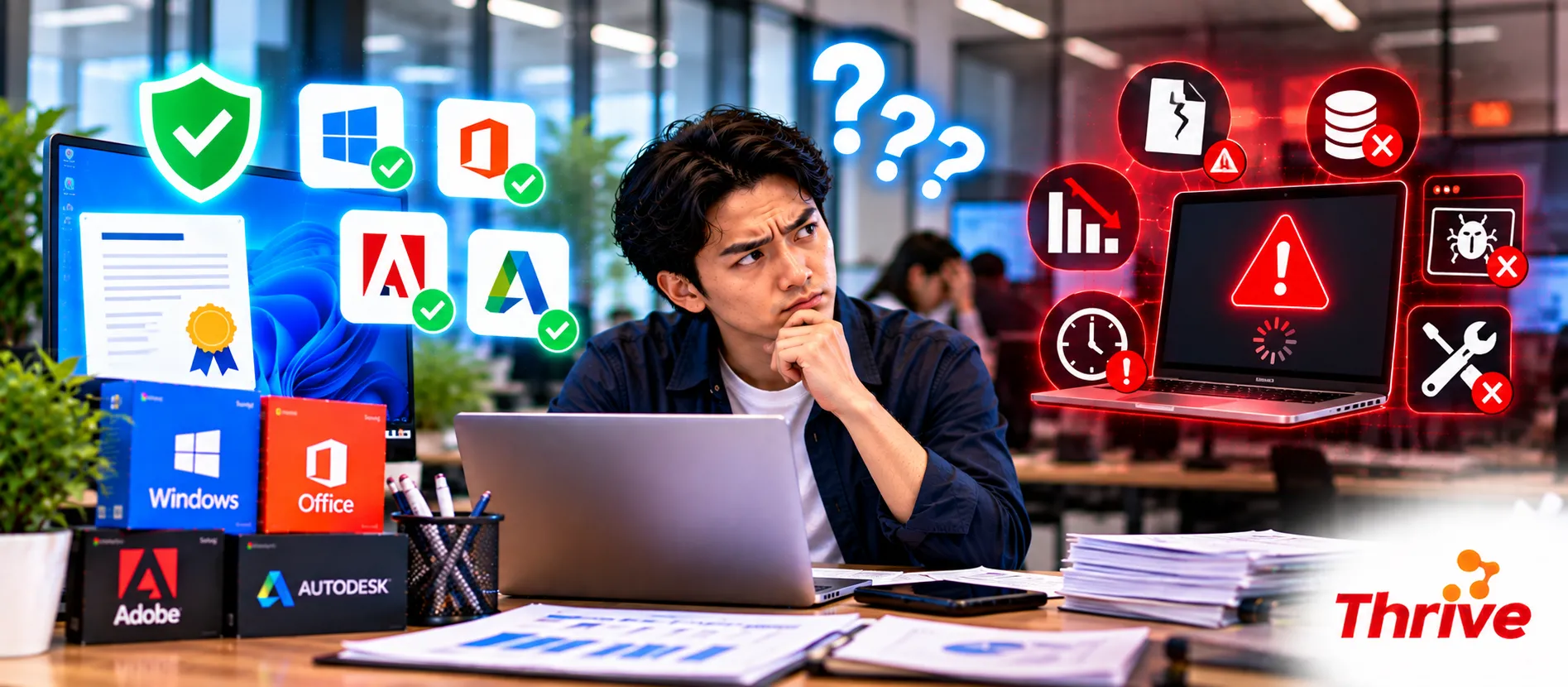
Software licensing costs often seem expensive because the amount is clearly visible in quotations or IT budgets. In contrast, the cost of system disruptions usually remains hidden until an actual problem occurs.
In reality, a single application being unavailable for just a few hours can stop multiple employees from working at the same time. Therefore, before considering affordable genuine software as an additional expense, companies should compare it with the potential costs of downtime, troubleshooting, recovery, and lost productivity.
License Costs Are Visible, Disruption Costs Are Often Hidden
20 employees × 2 hours of downtime = 40 affected work hours.
If the average labor cost is Rp50,000 per hour, the total reaches Rp2,000,000.
This does not yet include IT troubleshooting, data recovery, or delayed work.
The cost of affordable genuine software is better evaluated using Total Cost of Ownership (TCO).
For critical software, cost evaluation should cover at least 6–12 months to provide a more realistic business perspective.
What Costs Arise When a System Has Problems?
Software disruptions do not always mean the entire company server goes down. Smaller issues such as applications failing to open, activation problems, incompatible files, or software requiring reinstallation can also create real costs.
For example, if 15 employees are unable to work for three hours, assuming an average labor cost of Rp50,000 per hour:
15 × 3 × Rp50,000 = Rp2,250,000
That is only the productivity cost. Therefore, when evaluating affordable genuine software, companies need to consider the overall operational impact.
1. Downtime Can Affect Other Business Processes
One application is often connected to several other business processes.
When accounting software experiences problems, invoice creation may be delayed. When design applications are unavailable, marketing materials may be delivered late. When productivity tools are disrupted, administrative work can also slow down.
Using affordable genuine software does not guarantee that a system will never experience disruptions. However, software with clear licensing and a legitimate source is easier to integrate into IT update, inventory, and standardization processes.
This is why the cost of affordable genuine software should be viewed as part of operational expenses rather than merely as a purchase price.
2. IT Troubleshooting Also Has a Cost
When software fails, who fixes it?
If one IT staff member spends four hours diagnosing, reinstalling, configuring, and testing the software, that represents four hours of technical labor spent resolving the disruption.
If the same issue occurs five times, the total becomes 20 hours of IT work.
With centralized management of affordable genuine software, companies can establish standardized installers, version control, and more consistent documentation.
Information about affordable genuine software can also be recorded by user, device, version, number of seats, and renewal date, making troubleshooting more structured and efficient.
3. Recovery Can Cost More Than Prevention
The problem becomes more serious if a disruption causes corrupted files, lost configurations, or devices that need to be restored.
The cost may include reinstallation, backup restoration, security checks, reconfiguration, and the time users spend waiting for the system to return to normal.
Therefore, before rejecting affordable genuine software because the licensing cost seems high, compare it with the potential recovery costs if a critical application stops functioning.
4. Use TCO Instead of Looking Only at Purchase Price
A more appropriate business approach is to use Total Cost of Ownership.
A simple formula is:
TCO = License + Implementation + Support + Maintenance + Downtime + Recovery
With this calculation, affordable genuine software can be compared based on its total cost of use over one year rather than simply the amount shown on the invoice.
Companies can also evaluate whether the affordable genuine software is actually being used or whether there are unused licenses that could be discontinued during renewal.
Before Saying a License Is Expensive, Check These 6 Things
Calculate how many users actually need the software.
Determine the cost of downtime per hour.
Record the average amount of IT troubleshooting time required.
Include recovery and reinstallation costs where relevant.
Compare all of these costs with affordable genuine software over a 6–12 month period.
Review the use of affordable genuine software before renewal so the company does not continue paying for licenses that are no longer used.
FAQ
1. Is a more expensive software license always better?
No. Price is not the only indicator. Companies need to consider functionality, licensing model, user requirements, support, compatibility, and the total cost of using the software.
2. How do you calculate the cost of software problems?
Start with:
number of affected users × duration of disruption × labor cost per hour
Then add IT support, recovery, and other relevant operational losses.
3. Does genuine software never experience problems?
It still can. Affordable genuine software does not guarantee zero downtime. The difference is that companies can build more structured processes for software management, updates, and license documentation.
4. What are recovery costs?
Recovery costs may include time spent reinstalling software, restoring backups, reconfiguring systems, testing, and the productive work time users lose during the recovery process.
5. Do all employees need the same software licenses?
No. Conduct user mapping based on roles and work requirements so that the number of licenses matches actual usage.
6. How can companies reduce software licensing costs?
Identify unused seats, duplicate tools, and applications with overlapping functionality. Then adjust the number of affordable genuine software licenses based on the number of users who genuinely need them.
7. When should companies evaluate software costs?
At minimum, software costs should be reviewed at renewal or every 6–12 months. Compare pricing, actual usage, number of users, downtime, and support costs before renewing the licenses.
License costs are clearly visible from the beginning, while the costs of disruptions are often hidden within operational activities. That is why comparing software based on price alone can provide an incomplete picture.
By calculating downtime, productivity losses, support, and recovery costs, companies can evaluate affordable genuine software based on its actual impact on the business.
Ultimately, the decision to use affordable genuine software should be based on TCO, actual business needs, and business continuity, rather than only the amount listed on the invoice.
Related Articles
Also read other interesting information from us

General
Is WATI Cheaper than respond.io for WhatsApp Customer Service?
Quick Choice Before Choosing a WhatsApp CS PlatformWATI is suitable for businesses that focus on WhatsApp customer servi...

General
Best Graphic Design Software to Create Your Brand Logo
Choosing the right graphic design software is an important step in building your brand's visual identity. A logo is the...

General
Want a Stable Connection Anywhere? This is how Starlink solves it!
In the digital era like now, the internet has become a basic necessity for many people, especially for professionals who...
Get Free Consultation
Discuss your company's IT needs with our customer support right now at
+62 822 9998 8870


