Article Sep 16, 2026, 02:11 AM
Which Vendors Are Really Worth Choosing? Here's How AI Vendor Scoring Helps Procurement
How Can Vendors Be Assessed More Objectively?
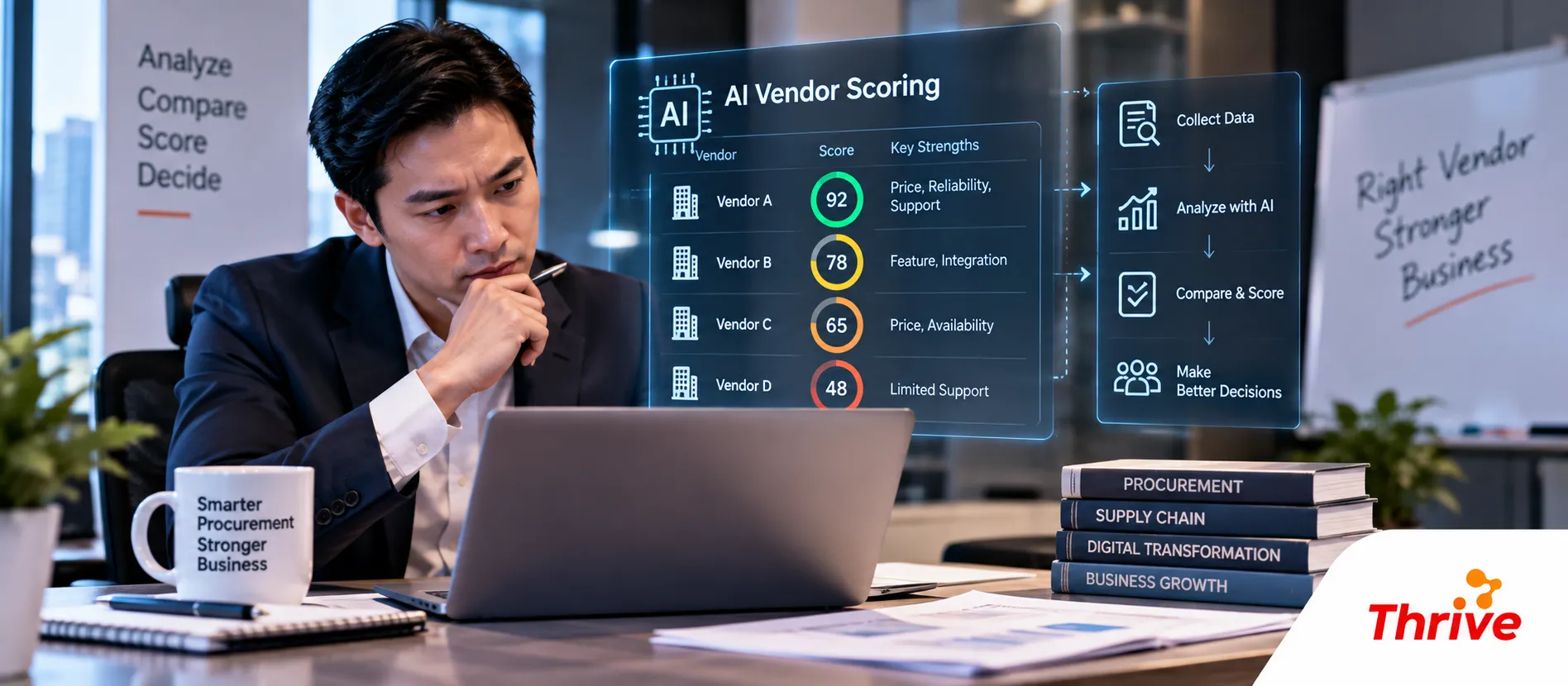
AI Automationcan help procurement transform vendor data into scores based on multiple parameters, rather than just looking at quotation prices. This approach is useful when a company has multiple suppliers with varying performance.
Pricecan be given a weight of 40%.
Quality of product or servicecan be given a weight of 25%.
Lead timeby 15%.
SLA and service responseby 10%.
Warranty or after-sales serviceby 10%.
Vendors with low scores can be directed toreview or re-evaluation.
For example, if there are 20 active vendors, Procurement can create categories.≥90 = Preferred, 75–89 = Approved, 60–74 = Monitor, And <60 = Review. This figure is an example of a threshold that can be adjusted according to company policy.
Why Doesn't Low Price Always Mean the Best Vendor?
In the field, the vendor with the lowest quotation does not necessarily produce the lowest costs in the long run.
For example, Vendor A offers a price of Rp100 million with a lead time of 3 days. Vendor B offers Rp92 million, but their average delivery time is 10 days. If the delay causes operational delays, the Rp8 million difference may no longer be a profit.
With AI Automation, procurement can combine quotation data with transaction history and vendor performance.
1. Determine the Parameters that Can Be Measured
Scoring will be more useful if the criteria have clear data.
For example:
Price → Total Cost
Performance → Delivery & Quality
SLA → Response & Resolution Time
Commercial → Payment Terms
Service → Warranty & Support
With AI Automation, the data can be collected from ERP, procurement systems, spreadsheets, or internal databases.
2. Calculate Performance Based on Actual Data
Don't just use subjective judgment.
For example, a vendor has20 shipping transactions. A total of 18 were completed according to SLA and 2 were late.
Compliance rate:
18 ÷ 20 × 100 = 90%
If the company's target is a minimum of 95%, the vendor needs to be in the categoryMonitor, even though the product prices are competitive.
With AI Automation, calculations like this can be done periodically from actual transaction data.
3. Include SLA in Score
SLA must have clear indicators.
For example:
Maximum response time:4 hours
Resolution target: 2 working days
Delivery target: 3 working days
If the average vendor responds within 8 hours, there is a gap in the SLA.
With AI Automation, the system can read the data and provide a flag when performance passes the threshold.
4. Combine All Parameters
Simple example:
Parameter | Weight | Score Vendor A |
Price | 40% | 90 |
Quality | 25% | 85 |
Lead Time | 15% | 80 |
SLA | 10% | 95 |
Warranty | 10% | 90 |
Final score:
(90×40%) + (85×25%) + (80×15%) + (95×10%) + (90×10%) = 88,25
The vendor is in the categoryApprovedif the company threshold sets 75–89 as a vendor that is still suitable for use.
With AI Automation, the formula can be run automatically every time the vendor data is updated.
What needs to be prepared for Procurement?
Define 4–6 main parameters.
Assign weight based on business priority.
Use actual transaction data.
Set threshold score.
Separate new vendors and existing vendors.
Create Preferred, Approved, Monitor, and Review categories.
Determine the evaluation period, for example everymonth or quarter.
Save the reason for the score change.
Create a notification if the SLA or score drops past the threshold.
Continue to conduct human reviews for strategic decisions.
Use legal software for companies and officially licensed software.
With this model, vendor scoring is more than just a report. The results can be used to determine which vendors to retain, negotiate with, or replace.
FAQ
1. What is vendor scoring?
Vendor scoring is a method of assigning values to suppliers based on parameters such as price, quality, performance, and SLA.
2. Should price be the biggest weight?
Not always. If quality and SLAs are more critical, the weighting can be increased.
3. How often do vendors need to be evaluated?
For active vendors, monthly or quarterly evaluations are quite common. High-risk vendors may be monitored more frequently.
4. Can SLA be calculated automatically?
Can. AI Automationcan calculate response time, delivery compliance, and other SLA indicators if the data is available.
5. What if the vendor performance data is incomplete?
Vendors can be assigned statusNeed Reviewor temporary scores. Don't create scores as if the data were complete.
6. Can new vendors be scored immediately?
Yes, but the criteria should be different. New vendors can be assessed based on quotations, documentation, certifications, capacity, and initial verification results.
7. Can vendor scoring be connected to ERP?
Yes. Procurement data from ERP can be used as a source for calculating and updating vendor scores.
8. Do the scoring results automatically determine the winning vendor?
Not necessarily. Scoring should be a decision-making tool. Procurement still needs to consider risks, business needs, and contractual conditions.
Related Articles
Also read other interesting information from us

General
Website for Business? Here's How to Make It in 5 Steps
Having a website is an important step in developing a business in this digital era. A website is not only the online fac...

How to Maximize Canva for More Effective Marketing Campaigns
Why Do Many Marketing Teams Rely on Canva?Canva helps you create campaign designs faster without professional design ski...

General
Pay for a License or Bear the Downtime? How to View Software Costs from a Business Perspective
Software licensing costs are often seen as an additional expense. However, from a business perspective, the question is...
Get Free Consultation
Discuss your company's IT needs with our customer support right now at
+62 822 9998 8870


